When One Viewpoint Dominates, Everyone Loses
At Davidson College, just 3% of faculty fall into a political minority, highlighting a clear imbalance.
According to the North Carolina State Board of Elections, the Davidson College faculty includes very few Republican Party-affiliated scholars. A DFTD investigation of publicly available voter registration records found that Republicans make up just 3.17% of the total faculty. In comparison, nearly half (46.03%) are registered Democrats, and the rest are unaffiliated (27.78%) or unregistered (23.02%). With all but six departments in the hard sciences and social sciences not currently employing a single Republican, this raises questions about ideological diversity at the college and whether certain voices may be excluded or disadvantaged in the hiring process because of their views.
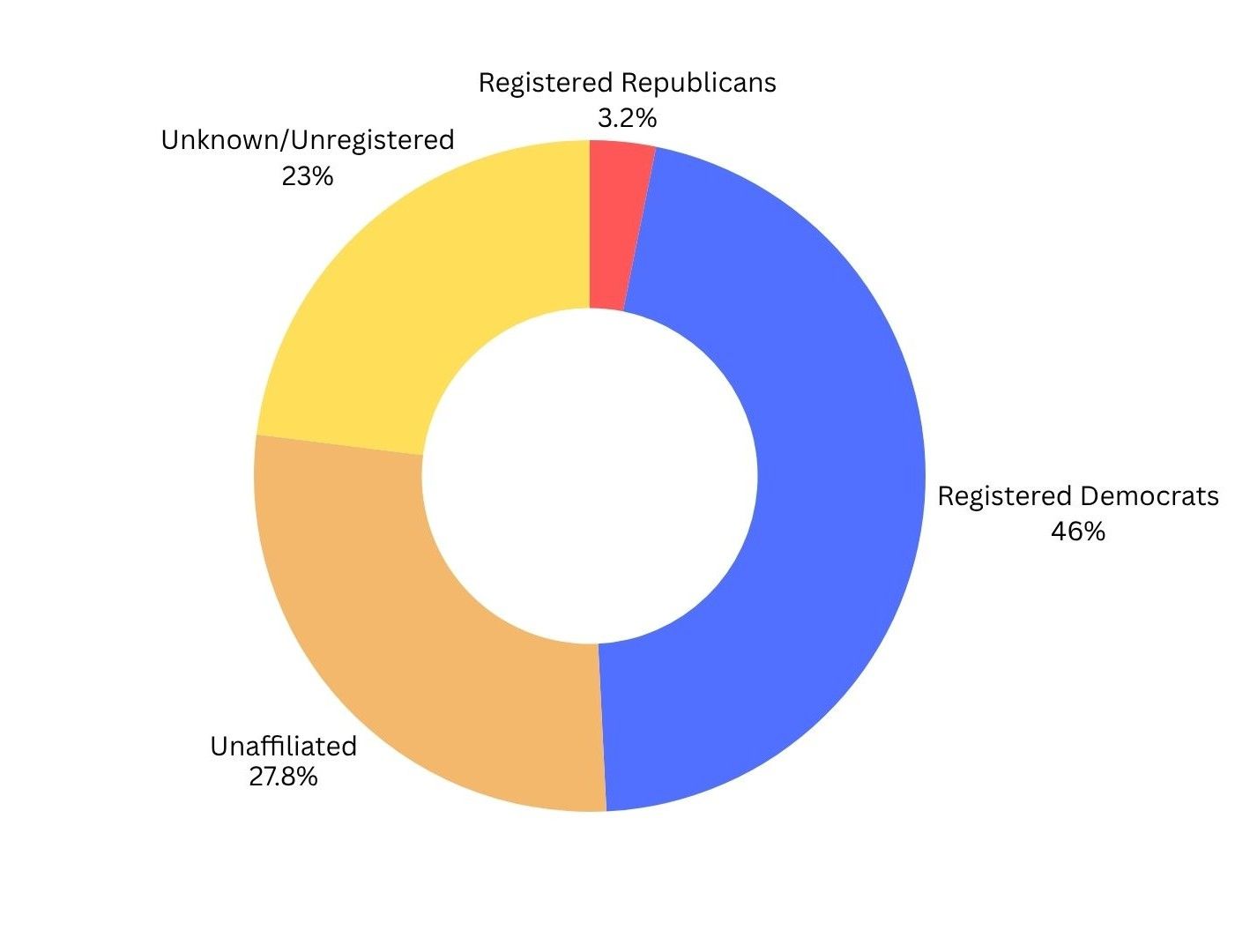
While this is not evidence itself that Republicans are barred from hiring in any way, or that political party affiliation accounts for all ideological preferences or a full ideological picture of the college faculty, the implications of such an imbalance, possibly influenced by bias in the hiring process, are concerning. In 2025, DFTD successfully advocated for the removal of ideological screening via diversity statements in hiring, but it will not be enough to truly impact political or ideological diversity. With faculty-driven hiring, the closed-loop model can reinforce any preexisting biases.
The need for a hiring process that considers the importance of including a wide range of perspectives is vital to a healthy academic culture. Without it, avenues of intellectual inquiry for students in class and among their professors as a faculty body are limited, and each person is deprived of the nuanced insights and challenges that an open faculty with a wider range of viewpoints can foster through rigorous disagreement and challenges to the biases of individuals across the political spectrum.
Although political affiliation is not the only factor to consider in creating an ideologically diverse learning environment, as the excellent scholars at Davidson College are more than capable of considering and fairly representing views that differ from their own, the partisan imbalance suggests that certain perspectives may be far more prevalent throughout the college. It remains important to consider whether such an imbalance creates conditions that allow for certain types of bias that would otherwise be challenged.
The quest for political diversity in higher education is in no way exclusive to Davidson. In the essay Diversifying the Academy, Professor Brian T. Fitzpatrick of Vanderbilt Law School lays out the dilemma of achieving political and ideological diversity as he has experienced it as a longtime member of the Vanderbilt Law faculty. We encourage you to read the full essay to get a sense of the importance and difficulty of maintaining a faculty makeup that features a wide range of viewpoints at any institution.
We hope the faculty will encourage courageous inquiry that remains open to thinkers of various perspectives. Such an aspiration is essential to maintaining standards of rigorous inquiry and thoughtful work free from bias. The presence of such standards is vital so that students can continually learn from the expectation to uphold them, thus enabling their adequate preparation for lives of learning, leadership, and service.