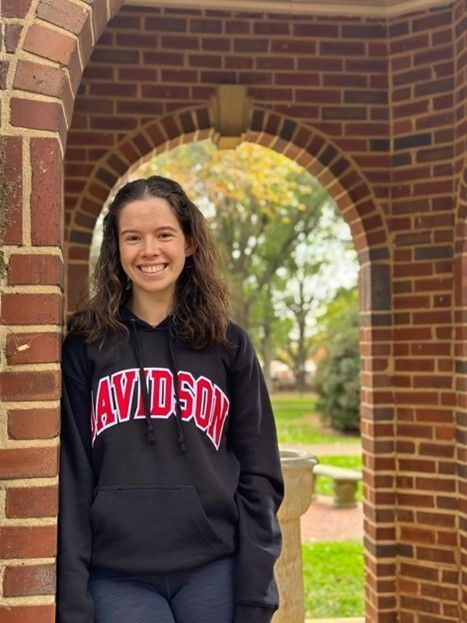
Student Spotlight: Emily Brestle '27


Student Spotlight


Emily Brestle ‘27, a spirited first-year student from Maple Valley, Washington, already embodies the essence of open dialogue. As someone who’s eager to engage in a conversation, and willing to consider all sides of an argument, it’s no surprise that Emily has found a home in the free speech movement in her first semester at Davidson. While considering a potential major in Political Science and Communications, Emily's involvement on campus spans a myriad of activities, from the Free Speech Alliance (FSA) to the pickleball and spikeball clubs, theater, YoungLife, and more.


Growing up in a suburb of Seattle, Emily has been accustomed to listening to a number of differing political opinions, which has laid the foundation for her robust support of free speech and civil discourse. As Emily puts it, “I am passionate about free speech because I grew up in an area where most people’s political beliefs differed from mine. It is important to me that everyone respects each other’s opinions even if they go against the accepted norm.”


Given her passionate support of discussion and debate, it is no surprise that she has found a deep appreciation for the Davidsonians for Freedom of Thought and Discourse. “I am thankful that DFTD helps fund a variety of different speakers on campus. It is important to listen to people who do not share the same beliefs as you to help broaden your perspectives. They are very supportive of the Free Speech Alliance and just want to help students feel like they have a place where they can share their opinions without fear of judgment,” she said. Emily dreams of a society where all viewpoints are equally respected, regardless of political affiliation.


Beyond her advocacy, Emily’s zest for life shines through her hobbies—paddleboarding, skiing, tennis, pickleball, and rock climbing. Her adventurous spirit has resulted in a few bumps, bruises and broken bones along the way, but you’d never know it given her optimistic and positive demeanor. As she makes her way through Davidson, Emily is considering becoming a sign language interpreter, and this summer, she hopes to enter a sign language study abroad program in Italy to further her aspirations.

Emily's infectious enthusiasm for open dialogue and civil discourse makes her a driving force for positive change on campus, at home, and everywhere she goes.



Make a Gift to DFTD


December 10, 2025
Written by John Craig December 10, 2025 On October 27, the Manhattan Institution’s City Journal published a major, breakthrough analysis of the performance of 100 prominent US (and one Canadian) universities and colleges, “Introducing the City Journal College Rankings,” For the first time, this new performance system includes data on measures (68 in all) like freedom of expression, viewpoint diversity tolerance, quality of instruction, investment payoff, and campus politicization that are not considered in the other major higher ed ranking systems. How did Davidson measure up in City Journal’s performance assessment? On a scale of one (bottom) to five (top) stars , Davidson is among the 63 schools that received 2 stars. Schools that, according to City Journal, have “Mostly average to below-average scores in all categories with no particularly noteworthy strengths. Significant, focused policy changes are needed at these schools.” (Full rankings available here College Rankings | Rankings ) To summarize the methodology, the City Journal team selected 100 schools that are highly touted by other ranking systems, widely known to the American public, and/or of high regional importance. The researchers gathered data on 68 variables across 21 categories covering four major aspects of on- and off-campus life. The Educational Experience categories were Faculty Ideological Pluralism, Faculty Teaching Quality, Faculty Research Quality, Faculty Speech Climate, Curricular Rigor, and Heterodox Infrastructure; the Leadership Quality categories were Commitment to Meritocracy, Support for Free Speech, and Resistance to Politicization; the Outcomes categories were Quality of Alumni Network, Value Added to Career, and Value Added to Education; and the Student Experience categories were Student Ideological Pluralism, Student Free Speech, Student Political Tolerance, Student Social Life, Student Classroom Experience, Campus ROTC, Student Community Life, and Jewish Campus Climate. No other higher ed ranking system includes as many variables. (Read more about methodology at College Rankings | Methods ) The data included publicly available information from sources such as the Integrated Postsecondary Education Data System (IPEDS), the Department of Education’s College Scorecard, and the Foundation for Individual Rights and Expression’s College Free Speech Rankings. The researchers also developed original measures for the project, such as the ideological balance of student political organizations and the partisan makeup of faculty campaign contributions. Each variable was coded so that higher values mean better performance and was weighted to reflect relative importance. For example, student ideological pluralism (as measured by self-reported student ideology and the left-right balance of student organizations) accounts for 5 percent of a school’s score while City Journal’s estimate of how many years it will take the typical student to recoup their educational investment to attend a given college accounts for 12.5 percent. A school’s overall score is the sum of points across the 21 categories, with the top possible score being 100. While the assessment system is for the most part hard-data-based, it has, like other ranking systems, subjective elements—like the weighing system. So methodological challenges will come and will doubtlessly lead to improvements the next time around. That said, the methodology strikes me as defensible and a marked improvement over that of other popular rating systems. I will conclude with some comments on the findings. Note that the Average score (out of 100) for the 100 institutions is 46 and the median score is 45.73—so overall, this is not a “high performance” group of institutions. No institution receives a 5-Star rating, and only two receive a 4-Star rating (University of Florida and University of Texas at Austin). Only 11 schools receive a 3-Star rating—Having “Mixed results across the four categories, showing strengths in some and weakness in others. These schools typically have several clear paths to improvement.” Because assessment scores are generally low and tightly clustered in the middle, the rankings by score are misleading: Davidson, at 51.16 with a rank of 25, looks to be in the top quartile (between Princeton and Georgetown), but in fact gets just a 2-Star assessment
November 11, 2025
Report from Ivy League school finds rampant grade inflation, but students complain administration is moving goal posts
October 30, 2025
Decades of big spending, new federal funding cuts and a changing view of higher education created a perfect storm; ‘Spending Your Tuition On Its Mistakes’
Show More